

About the Willow Rock Energy Storage Center
Located in East Kern County, California, the Willow Rock Energy Storage Center will provide 500 MW of reliable capacity and 8 hours of energy storage.

GRID NEEDS
Providing Reliable Power
to California’s Grid
50%
Increase in electricity demand by 2045
California is facing major load growth. Meeting future demand will require large-scale, long duration storage to support reliability and to maximize the use of increasing levels of intermittent generation capacity.
1000+
Construction jobs supported during construction
The project will support thousands of jobs and create over 700 construction jobs at peak. The total construction man-hours for the project will exceed 2 million, reflecting the scale and scope of the work involved.
25-40
Full-time positions created during operation
These roles will utilize highly skilled professionals, with job functions similar to those in the county's established oil and gas industry, providing stable, long-term employment opportunities and stimulating economic growth.
400k
Powered for eight hours
The 500 MW project will be built on a site of ~100 acres, and can provide power for more than 400,000 homes for eight hours.
Storage Center Location
Serving the Needs of Kern County
Built for Energy Reliability
Located approximately 1.5 miles north of Rosamond, CA
Thousands of jobs supported during construction, with 40+ full-time positions for the facility’s 50+ year operational lifetime
Will deliver over $500M in economic benefits to the regional economy during construction
Expected to be operational in 2030
100% emissions-free operations
Our Company
Energy Storage Built for California
Who we are
Hydrostor is a leading global developer and operator of long duration energy storage systems, with the Willow Rock Energy Storage Center in Kern County serving as its flagship project in the U.S. As California’s electricity demand grows, Willow Rock demonstrates how long-duration energy storage strengthens grid reliability and ensures dependable power for homes and businesses across the state. Founded in 2010, Hydrostor developed its patented advanced compressed air energy storage technology (A-CAES) to deliver long duration energy storage that power grids around the world, using compressed air and water to store energy.
Our track record
In addition to the Willow Rock Energy Storage Center, Hydrostor has had a 2 MW demonstration facility in Goderich, Ontario, that has been serving Ontario’s grid for over five years. Hydrostor also has late-stage developments in New South Wales, Australia, along with a 7 GW project pipeline throughout Canada, Australia, the UK, and the U.S.
The Technology
How Does A-CAES Work?
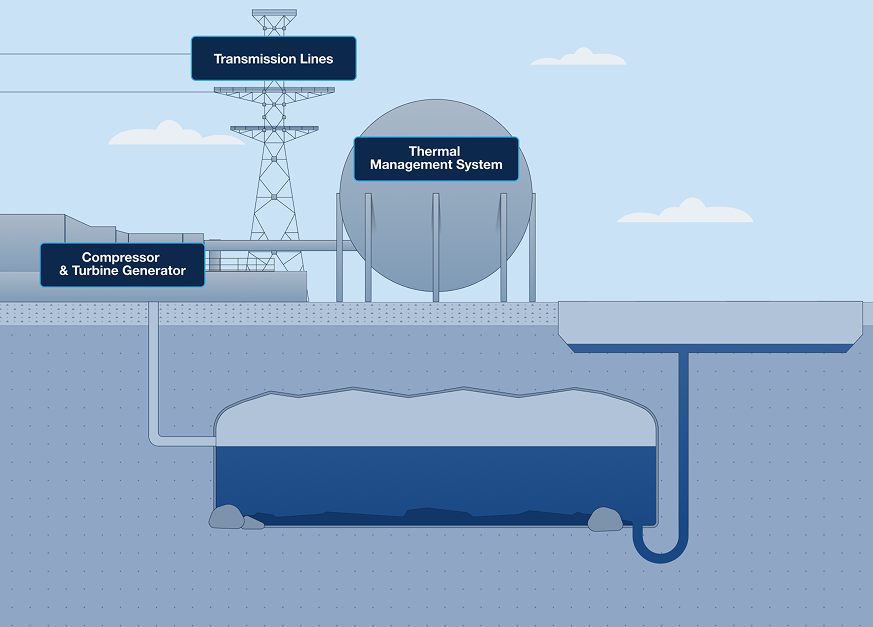
Compressed air energy storage (CAES) technology has been used globally for decades, but wasn’t widely deployed because of siting constraints and cost. Hydrostor has made improvements to traditional CAES to make it more economic and more flexibly sited – this technology is called advanced compressed air energy storage, or A-CAES.
1. Charge the system
During times of abundant nuclear, solar, or wind generation, Hydrostor’s A-CAES uses the extra energy to charge the system by compressing ambient air. The heat generated as the air is compressed is captured and stored above ground. It will be needed later.
2. Store the energy
Once the heat has been removed, the cooled, compressed air is pushed into a cavern underground that is filled with water and connected to a surface reservoir. As air is injected into the cavern, an equivalent volume of water is pushed out of the cavern and up into the surface reservoir, maintaining constant pressure within the cavern while operating. The system is now charged, and the potential energy can be stored until it’s needed.
3. Discharge to the grid
When it’s time to discharge energy back to the grid, the process reverses. Water is released to flow from the surface reservoir back into the underground cavern, pushing compressed air up to the surface. The air is reheated using the stored heat from the charge process and is used to drive air turbines, generating electricity that can be fed back onto the grid.
Advantages of A-CAES

Cost-effective at long durations
Lower costs than batteries for storage durations of eight hours or more.

Flexible siting in hard rock
Can be developed in hard-rock formations rather than salt caverns, meaning it can be sited where the grid needs storage.

High energy density
Delivers 500 MW using a footprint of under 100 acres, making efficient use of local land resources.

Simple, proven materials
Only rock, air, and water, used in operations, with no hazardous materials.

Limited environmental risks
Avoids fire risks and the use of critical minerals associated with lithium-ion battery systems.